
What It's Like to Walk Where Jane Austen Walked
By Joan Weber | Nerds Tour
On Weeping at Beauty
In 1995 I was working at the Peabody Institute in Baltimore, in the Preparatory Division — the program that trains young musicians and dancers, as well as adults, to any level they wish to aspire. After hearing hundreds of renditions of young violinists playing Go Tell Aunt Rhody, I was not easily moved.
And then one evening Midori performed at a Peabody fundraising event. I was there for work; she drew the bow across the first string, and tears dropped onto my dress before I knew they were coming. They didn't stop for the entire concert.
It has happened ever since — in the presence of certain music, certain paintings, certain places. The weeping arrives before thought does. Sometimes a gasp comes first, the breath knocked out before anything else. Twice in my life I have swooned. Once in front of Artemisia Gentileschi's Judith Beheading Holofernes. The other time I will come to in a moment.
I have no control over it and I have stopped trying to explain it. When people see me weeping in a cathedral and ask if I am all right, I tell them I have a syndrome. That usually settles it.
How It Began
In the summer of 2018, Bread Loaf — my graduate school alma mater — paid me to be in Oxford, administering their summer program from Lincoln College. Room and board were covered. That kind of freedom, when you are already in England, is an invitation you do not refuse. My first literary pilgrimage was Shakespeare — Stratford-upon-Avon, the house on Henley Street, the church where he is buried. I wept all over Stratford and understood that I had found a new way to be in the world.
Three years later I came back for an entire summer and made it count. I drove around England on pilgrimages — a cathedral pilgrimage, an Austen pilgrimage, a Brontë pilgrimage — in the cutest little Fiat 500 that made me happy every time I started it. England was still half-asleep, just opening after the long stillness of the pandemic, and I had it almost entirely to myself.
On the way, my husband and I had stopped in Normandy for Mont-Saint-Michel — a place I had been dreaming of since the ninth grade, when my French teacher first described it. The tears arrived before I even reached the abbey. I paused the weeping long enough for friendly French strangers to take photos of us with the spires rising behind us, and I have those photos still. That trip deserves its own post someday, because it was filled with magic at every step. But this story is about Jane.
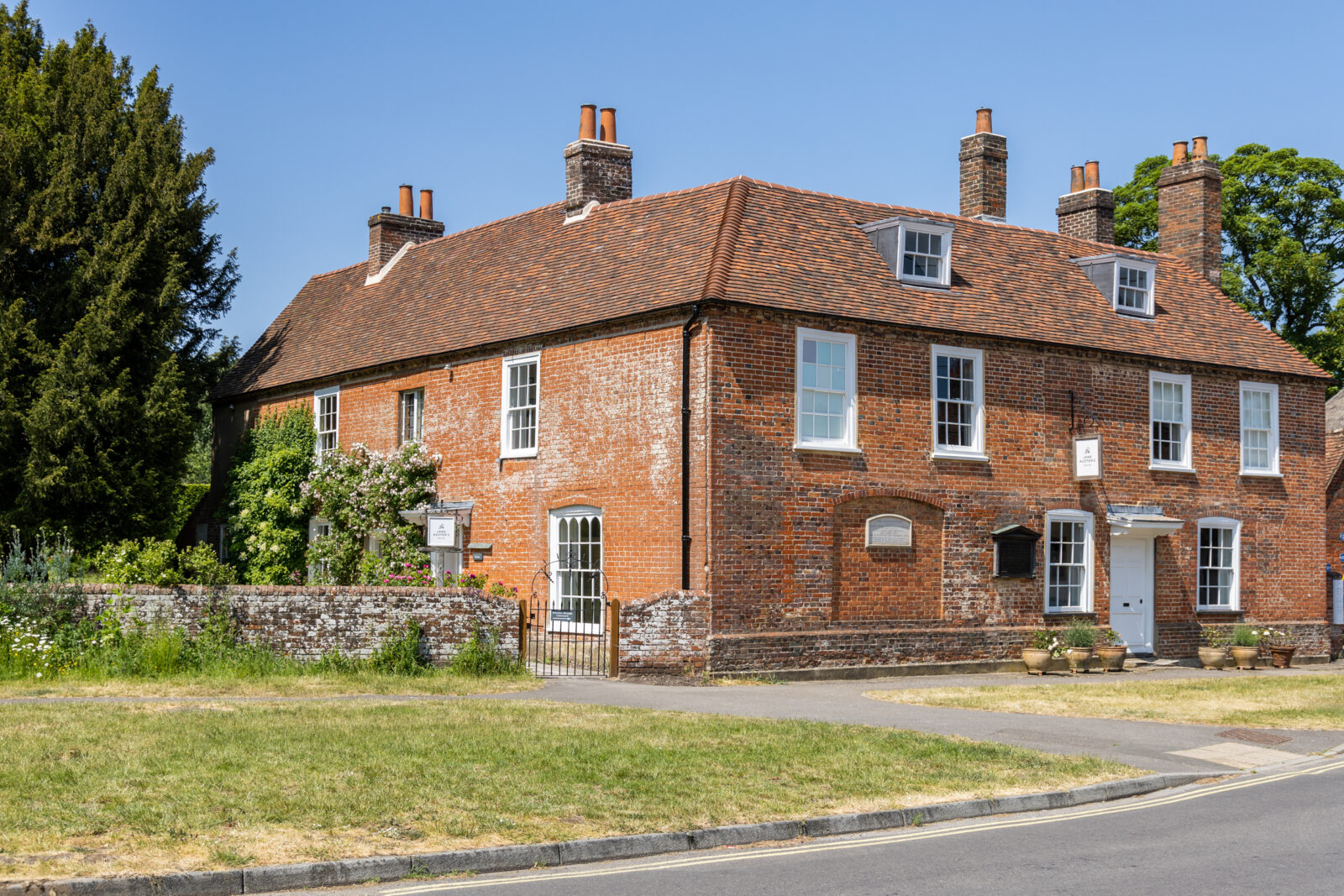
Jane Austen’s Cottage in Chawton, Hampshire
Hampshire
I drove into Hampshire listening to audiobooks — Jane Austen: A Secret Radical and Pride and Prejudice — her world filling the little Fiat as I drove through the county she never really left. I got a remarkable number of things wrong. Wrong turns, wrong car parks, wrong assumptions about distances. It didn't matter.
Bath came first. I stayed in a youth hostel above the city — an old manor house that felt exactly right — and walked down into the Georgian terraces each morning, learning the city the way Austen's characters learn it: on foot, slowly, paying attention. I began to understand something important about why she wrote about Bath the way she did — with such precision and such detachment. Bath is a city where geography creates social status. The higher you live, the more fashionable your address; the lower you fall financially, the further down the hill you move. Austen knew this because she lived it. Her family moved house repeatedly in Bath as their circumstances shifted. She could see the social machinery turning underneath all that beautiful stone, and she wrote it down.
The Wallpaper
Chawton is a small village in Hampshire. Jane Austen lived in the cottage there from 1809 to 1817 — eight years in which she revised Sense and Sensibility and Pride and Prejudice for publication and wrote Mansfield Park, Emma, and Persuasion from scratch. She worked at a small table in a room that anyone could walk through at any moment, hiding her pages when visitors came, the door hinge left unoiled so she would hear someone approaching.
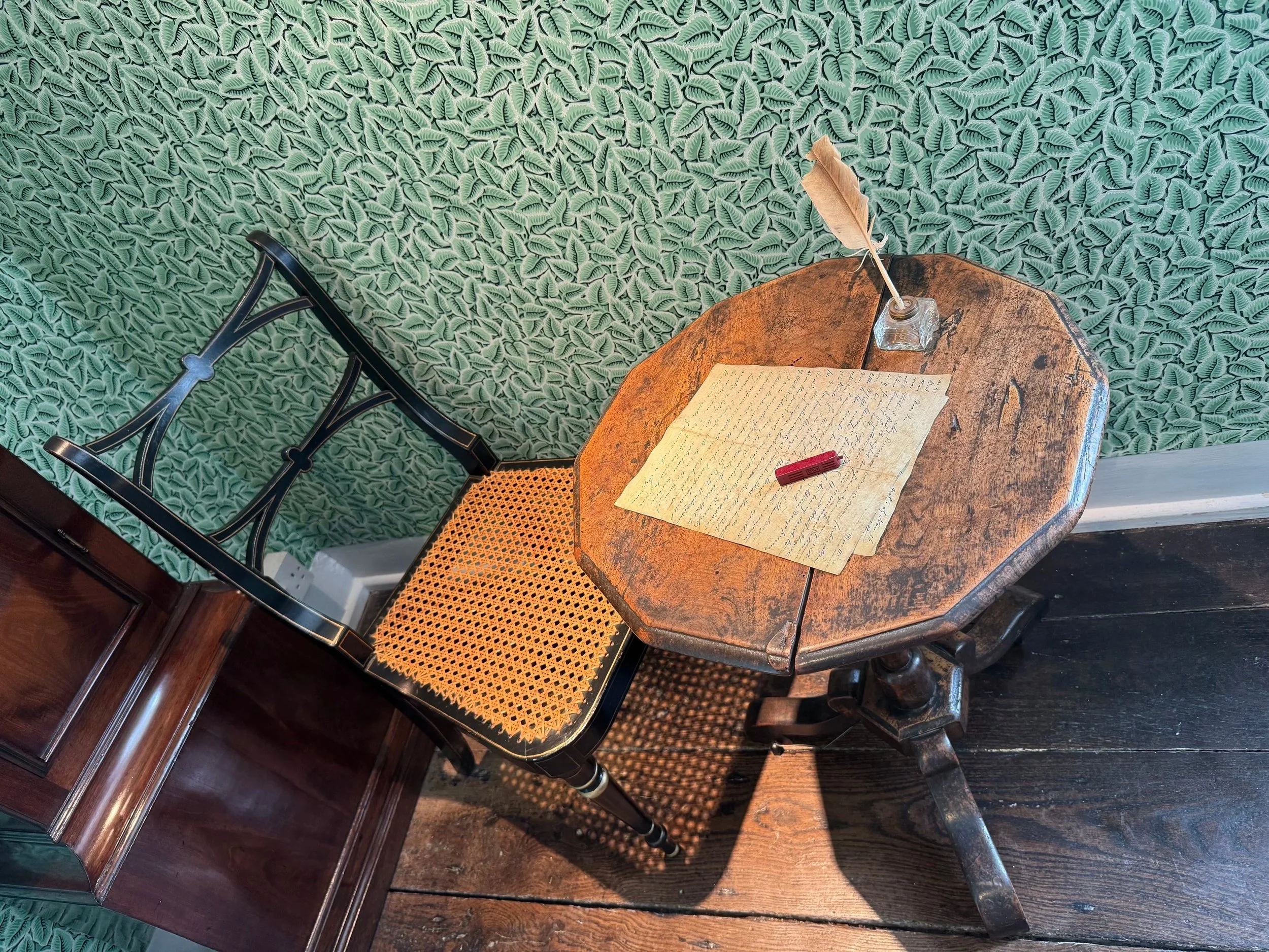
Jane’s writing desk at Chawton Cottage
The cottage has been lovingly restored. The wallpaper in the dining room is historically researched and reproduced — you can read the full story on the cottage's own website. My personal favorite is the Chawton Leaf. I fell in love with the wallpaper while imagining her writing at that little desk.
I stood in the room and the tears came.
It sounds like a small thing. Wallpaper. But what undid me was the realness of it — the sudden absolute proof that she had stood in this same room, looked at these same walls, and then sat down at that small table and written sentences that will outlast everything. The wallpaper made her a person in a way that her novels, strangely, sometimes don't. She became someone who had opinions about wallpaper. Who had to live in a house. Who was a specific, small, real woman in a specific place. I loved the pattern so much that I have bought objects from the gift shop with that design on it, and I intend to cover a room in it one day. There is something quietly thrilling about discovering that you and Jane Austen have similar taste. Sometimes beauty is worth the tax.
I learned how small she was when I saw her dress. I had read a lot of biographies. I had taught Northanger Abbey for years. And still, standing in front of the actual dimensions of the garment she wore, I had to recalibrate everything. All that wit, all that precision, all that magnificent controlled fury — in this small person, at this table, looking at this wallpaper.
I went outside and wept in the garden.
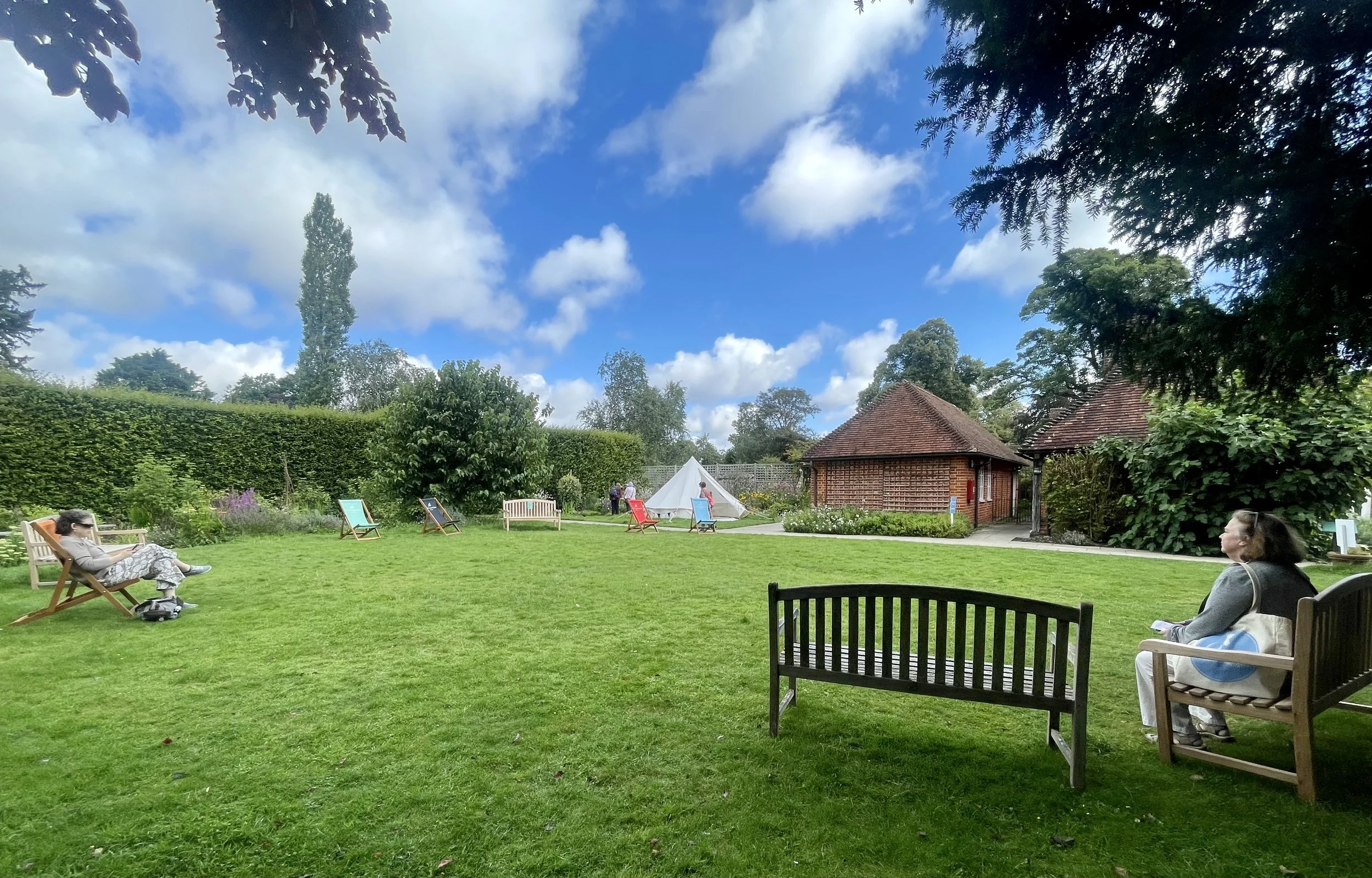
Me, probably weeping, in the garden at Jane Austen’s cottage, 2023
A word about Cassandra, because she deserves one. Jane Austen was able to write the way she did because her family made it possible. Her mother, her sister Cassandra, and Martha Lloyd managed the household so that Jane was largely free from domestic labor. Cassandra in particular organized her whole life around her sister's need for time and quiet. She is everywhere in that cottage, in the invisible infrastructure of every novel Jane wrote there.
Winchester
Winchester is where Jane Austen came to die. Her life followed a particular geography — born in Steventon, where her father was rector; her happiest and most productive years in the cottage at Chawton; and finally Winchester, where she came in 1817 to be near a physician. She was 41 years old and ill. She died in July at 8 College Street, in a rented room. I follow that chronology as closely as the practicalities of travel allow, because the places only fully make sense in the order she lived them. It has become a principle I carry into every curated tour I build.
She is buried in Winchester Cathedral, in the north aisle, beneath a stone that does not mention her novels.
I had to sit down when I found her grave.
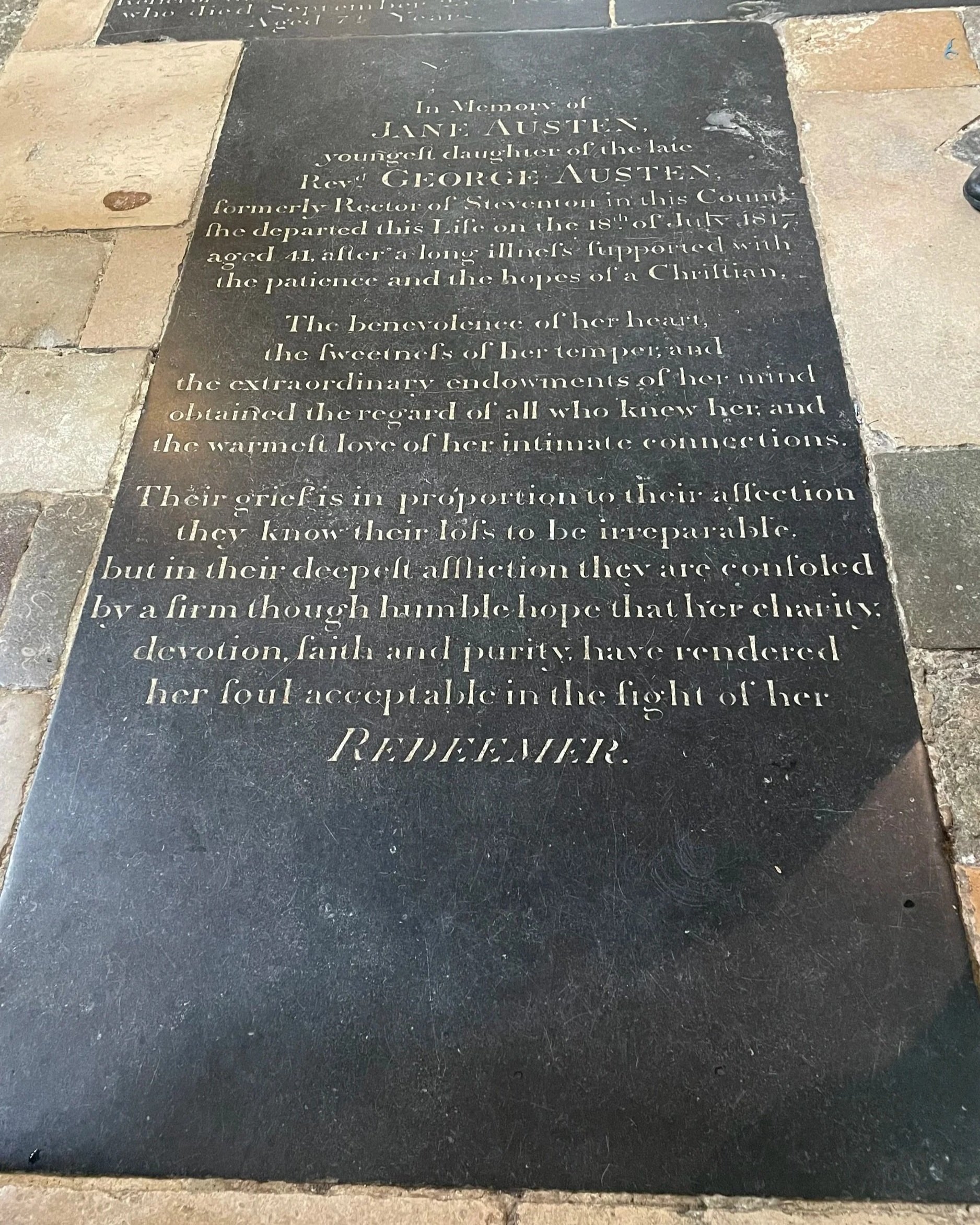
Winchester Cathedral, north aisle. July 18, 1817. She was 41.
I read everything — the inscriptions, the windows, the tributes left by visitors over the years, the brass plaque added later when people felt the original stone had not said nearly enough. I sat with it for a long time. She was 41. Sanditon was unfinished on her desk.
On a later visit, our guide walked my group to the house on College Street and told us about the funeral procession. Women were not permitted to attend funerals in Regency England — considered too emotional, too unseemly. And so Cassandra — who had nursed her sister, who would later carefully burn much of Jane's correspondence to protect her privacy, who had quietly built her whole life around making Jane's writing possible — had to watch from a window as the wagon carried her sister away to the cathedral.
I wept. I always weep at this. It is so very sad, and Cassandra deserves every one of those tears.
Winchester is a city I fell in love with on that first visit and have returned to many times since. It rewards a full day of wandering, and I will write about how to do that properly another time.
Why I Built This
When I came home from that summer I looked for someone to take me back — a company that specialized in exactly this kind of travel, literary pilgrimage for people who wanted to go to the room where it happened and stand in it. I couldn't find one. Not for this. Not with this kind of depth and intention.
So I built it myself.
Nerds Tour exists for people who travel the way I do — toward places that mean something, toward stories they want to inhabit from the inside. People who already have an emotional relationship with a place before they arrive. People who, when they stand in the right room, find their faces unexpectedly wet and understand completely why.
Adventure is my dopamine. I built a business around sharing that with people who feel the same way.
The Austen Adventure, October 2026
This October I am leading an escorted Austen Adventure — seven days through Bath and Winchester, walking the streets she walked, staying in the city she lived in, visiting the cathedral where she is buried. This particular escorted group departure has a small number of spots remaining.
If you are a pre-formed group — a book club, a group of friends, a school alumni association — I am always available to build and lead a private Austen journey designed around your timeline and your pace. That conversation starts whenever you're ready.
But if you want to join this October, now is the time.
See the full itinerary and reserve your spot.
Or if you'd like to talk it through first: schedule a free consultation and let's find out if this is your trip.
Joan Weber is the founder of Nerds Tour, a boutique travel agency for people who want to go to the room where it happened. She spent decades as a teacher, theatre educator, and arts administrator putting people inside stories and beauty — and now she takes them there in person.
