
Be a Tourist in Your Own Backyard
By Joan | Nerds Tour
The Diner and the Battlefield
About twenty years ago, my friend Jen gave me some advice I have never forgotten. She told me she made a point of visiting her own town as a tourist would — booking tours, going to museums she had always driven past — and that it changed how she felt about where she lived. This does not require a vacation. It requires an afternoon and a willingness to learn what you have been walking past your whole life. I filed that away and eventually did something about it.
I grew up near Gettysburg, Pennsylvania. For most of my childhood, Gettysburg meant one thing: the Lincoln Diner, a classic American diner on Carlisle Street with an extensive menu, great desserts, and the kind of breakfast that makes you reconsider everything you thought you knew about scrapple. My family drove through the battlefield regularly to get there. We parked, we ate, we drove home. I took a Civil War course at some point. I learned about troop movements and battle formations and which general made which tactical error on which day.
I knew almost nothing about Gettysburg.
It took a bus tour and a guided walk — booked on a whim when a friend wanted to sightsee — to change that. Within an hour I was hearing stories that no classroom had ever told me, about the people who lived in that town when the war arrived on their doorstep. About what the battle looked like from inside a house rather than from a command tent. About women, specifically, because history books have never been very interested in women, and tour guides — the good ones — are.
Elizabeth Thorn
Peter Thorn was the keeper of Evergreen Cemetery in Gettysburg. When the war came, he went to fight with the 138th Pennsylvania Infantry, leaving his wife Elizabeth in charge of the cemetery — a promise she had made him and intended to keep. Elizabeth was thirty years old, the mother of three small boys, and six months pregnant with their fourth child. Her parents, elderly German immigrants who spoke no English, lived with her at the cemetery gatehouse.
On July 1, 1863, the first day of the battle, the Union army was pushed back through Gettysburg toward Cemetery Hill — toward Elizabeth's home. A member of General Howard's staff knocked on her door and asked for a man who could orient them to the roads and the lay of the land. Her father was the only man present. He spoke no English. Elizabeth offered to go herself.
She walked through fields of flax and oats and wheat with the Union officer, six months pregnant, identifying the York Road and the Harrisburg Road and the Hunterstown Road while the battle began around them. When other soldiers saw her in the field and questioned her presence, her escort vouched for her. The men gave three cheers. The band played.
That evening, three Union generals appeared at her door for dinner. Generals Sickles, Howard, and Slocum. The Confederates had already eaten everything in her pantry. She fed them what she could. Her three small boys watched General Howard's empty sleeve — he had lost his arm at the Battle of Seven Pines the year before — flap in the air as he talked, transfixed.
As the generals left, Howard told Elizabeth to take her children and her parents and leave. She had ten minutes. Take nothing.
She left.
When she returned after the battle, her home had been gutted. The furniture was gone — she spotted some of it passing on Union wagons down the pike, her boys begging her to stop it. The windows were broken. The mattresses were soaked with blood. The pump was broken. The stench of death was everywhere.
She fixed the pump. She spent four days washing what was left.
Then she was told to dig graves.
In the intense July heat, with only her father to help — two soldiers had volunteered but the smell defeated them after two days — Elizabeth Thorn buried nearly one hundred soldiers and several civilians. She was heavily pregnant. She wore the same dress for six weeks. Each body she buried was, she later said, someone's son or someone's husband. She thought about that as she dug.
Three months after the battle, she gave birth to a girl. She named her Rose Meade, after the Union commander. Rose was never strong. She died at fourteen.
Elizabeth's own summary of everything she had endured: "Those were hard days."
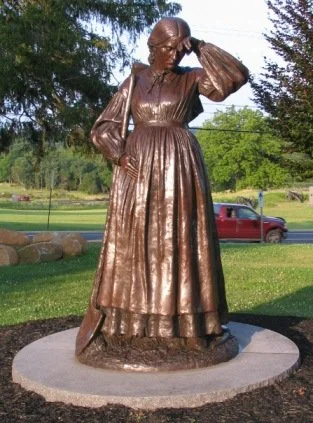
The Gettysburg Civil War Women's Memorial, likeness of Elizabeth Thorn. Sculptor: Ron Tunison. Copyright gettysburgsculptures.com
There is a statue of her now at Evergreen Cemetery. I had driven past that cemetery hundreds of times on the way to the diner. I had no idea she existed until a guide told me her story as we stood in front of the monument and I could look at her face.
Ginnie Wade
Mary Virginia Wade — everyone called her Ginnie — was twenty years old when the Battle of Gettysburg began. She was at her sister's house on Baltimore Street, helping care for a newborn, when a bullet came through two doors and killed her. She was the only civilian killed in the battle. She is famous for that, in the way that women in history are often famous for dying rather than for living.
What the tour guide told me about her living is the part that stayed with me.
Ginnie's father, Captain James Wade, was by any measure a difficult man. By the 1850s, after a series of legal troubles — assault, larceny, accusations that would raise eyebrows in any century — his wife Mary Ann had him declared insane and committed to the Adams County Alms House. This was not the genteel institution the name might suggest. It was a catch-all for the criminally insane, the desperately poor, the ill, and the addicted. Residents who proved difficult were chained to iron balls. An 1886 document refers to a room called the dungeon. Captain Wade, listed in the 1860 census as very insane, was almost certainly there for the duration of the battle.
His daughter was killed a mile away.
The Alms House itself sat on Blocher's Knoll, directly in the path of the fighting. The wounded began arriving during the battle, filling the basement. One of them was Bayard Wilkeson, eighteen years old, whose father was a correspondent for the New York Times. His father later wrote of finding his son dying in that basement, in a low damp room, bleeding to death for hours, calling for his parents. Captain Wade, possibly chained to a wall above him, would have heard everything.
Growing up near Gettysburg, I knew none of this. I knew about Pickett's Charge. I did not know about the women and the civilians and the father in the alms house and the daughter in her sister's kitchen and the pregnant woman burying the dead because someone had to.
A tour guide told me. In an hour on foot, I learned more about what that battle actually was than I had in a lifetime of driving through it.
What Jen Knew
My friend Jen was right. The place you live is full of stories you don't know yet, and the fastest way to find them is to stop being a resident and start being a tourist. Book the tour. Go to the museum. Eat at the diner everyone recommends to visitors but that you have never tried. Ask the guide your questions because they have done the research you haven't and they will tell you things that will stay with you for the rest of your life.
The best guides are the ones who give you the human story — not just what happened, but who it happened to and what it cost them. Those are the stories that make a place real in the way that road signs and battlefield markers never do.
If you don't know where to start, Viator is where I go first. Type in your city or your region and you will find guided walking tours, food tours, history tours, ghost tours — things you never knew existed in the place you have lived for years. The guides on Viator are vetted, reviewed, and almost always local — which means they know things about where you live that you don't.
Start with your own backyard. Search tours near you on Viator.
I receive a small commission if you book through that link, at no cost to you. I only recommend things I use myself.
One More Thing About the Lincoln Diner
Go. Everything on the breakfast menu is excellent. Try the scrapple if you have never had it — crisply fried, it is a cultural experience and a Pennsylvania tradition that deserves more respect than it gets. I always tell travelers to eat like the locals eat, even when it's unfamiliar. The broasted chicken is not to be missed but it is a lot of food, so plan accordingly. I usually get dessert on the way out because I am always too full at the end of the meal to manage it at the table. The display case near the door will make that decision very easy.
It is on Carlisle Street. You cannot miss it. The sign has Lincoln's face on it, which feels appropriate given the address.
Joan Weber is the founder of Nerds Tour, a boutique travel agency for people who want to go to the room where it happened. She spent decades as a teacher, theatre educator, and arts administrator putting people inside stories and beauty — and now she takes them there in person.
