
In mid-September, I set out from St. Petersburg, Florida, to drive home to Betterton, Maryland, and I stayed off the interstate for as long as I possibly could. I started north on U.S. 19 along Florida's Gulf Coast, and later I spent a long stretch of the trip on U.S. 13. I drove alone this time, which meant every stop and every detour was mine to choose.
The first stop was never in question. I was going to see the mermaids.
North on U.S. 19
The drive begins in Pinellas County, the most densely populated county in Florida, with 3,425 people to the square mile. U.S. 19 runs straight up the middle of it. It takes a while to leave the city behind, and then the road carries on north toward Weeki Wachee, the same road that brought travelers to the mermaids long before there was an interstate to bypass it.
Weeki Wachee, the first time
Weeki Wachee Springs sits right on U.S. 19. To me it is a living piece of old Florida, and a romantic place, in the literary sense. It has kept going, even though it is much smaller than it once was.
I first visited about fifteen years ago, when my kid was about eleven. I made everyone go, because I wanted to see whether it was still running. I had read about the commercial venture failing, and I cheered when the State of Florida stepped in and made it a state park in 2008. When we got there, I was so happy to find that it still used the same theater. There were only three swimmers that day, and it was Christmastime, so everything was decorated for the holidays. It was still pretty magical.
Before Florida was Florida
In 1946, U.S. 19 was a two-lane road running through scrub and swamp, and the side roads were dirt. There were no gas stations, no groceries and no movie theaters for miles. Alligators and black bears outnumbered the people. Beside the road lay a spring so clear you could see forever, and it was full of rusted refrigerators and abandoned cars.
Newton Perry, a former Navy man who had trained frogmen during the war, looked at that spring and saw mermaids.
He hauled out the junk. He worked out a way for a swimmer to breathe from a free-flowing air hose fed by a compressor, so she could stay down without a tank. The mermaids still breathe from that same kind of hose today. He carved an eighteen-seat theater into the limestone, six feet under the water, and he taught young women to dance there. He even taught them to eat bananas and drink Grapette beneath the surface, and the mermaids still drink underwater in the show.
The first show opened on October 13, 1947. Hardly anyone drove that lonely stretch of highway, so whenever the mermaids heard a car coming, they ran out to the road in their swimsuits and waved it in.
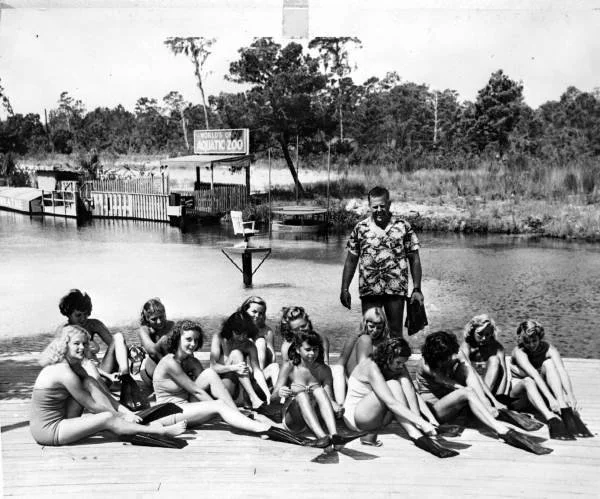
Newton Perry with mermaids in training, 1948. State Archives of Florida, Florida Memory.
Then the whole country came
By the 1950s, that little roadside spring was one of the most famous stops in America. Hollywood came to film Mr. Peabody and the Mermaid in its waters, with Ann Blyth as the mermaid. In 1959, ABC bought Weeki Wachee and built the grand theater, sixteen feet down, where four hundred people could sit at once and watch the spring come alive. The shows became productions: pirates, an underwater circus, Alice tumbling into Wonderland, Peter Pan flying through the blue.
Thirty-five mermaids performed eight shows a day and lived in cottages behind the theater. As many as half a million people a year came down that two-lane road to see them. In 1961, Elvis Presley arrived while he was filming Follow That Dream, and three thousand fans arrived with him. Don Knotts came. And Esther Williams herself, the queen of the water ballet, came to see the mermaids.
That is the Florida I keep chasing: the magical creation time, when someone looked at a spring and imagined mermaids, and the whole country drove down to see them. When I sit in that theater, it transports me there.
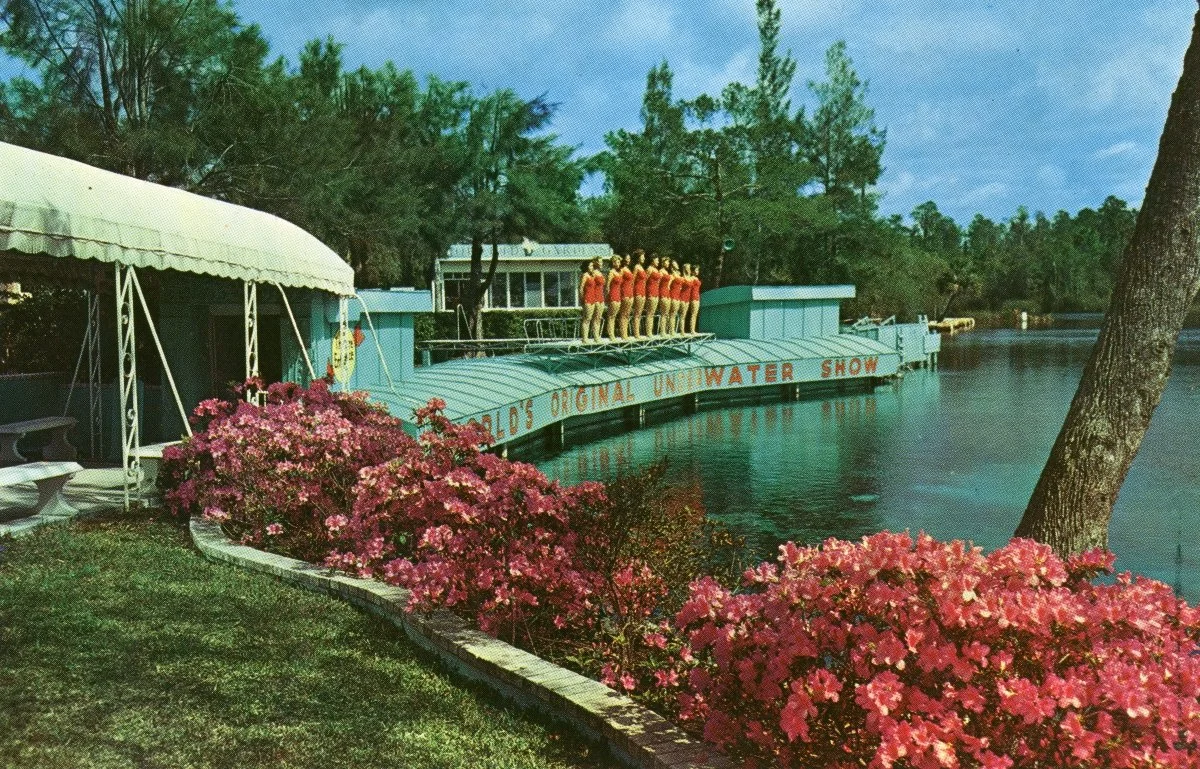
Mermaids above the new underwater theater, around 1959. Photograph by Ted Lagerberg, State Archives of Florida, Florida Memory.
A morning with the rangers
I arrived well before the mermaid show, so I started on the opposite side of the park from the theater, past the boat dock, where the park rangers give their wildlife show. Weeki Wachee is a state park now, and the show is a lecture and demonstration on the animals of the region. We met tortoises, an alligator and a bird. The ranger came back again and again to taking care of this place, and so, later that afternoon, did the mermaids.
It's a timely message. Florida is still in a deep drought, and the park's river cruise was paused until the water rises again.
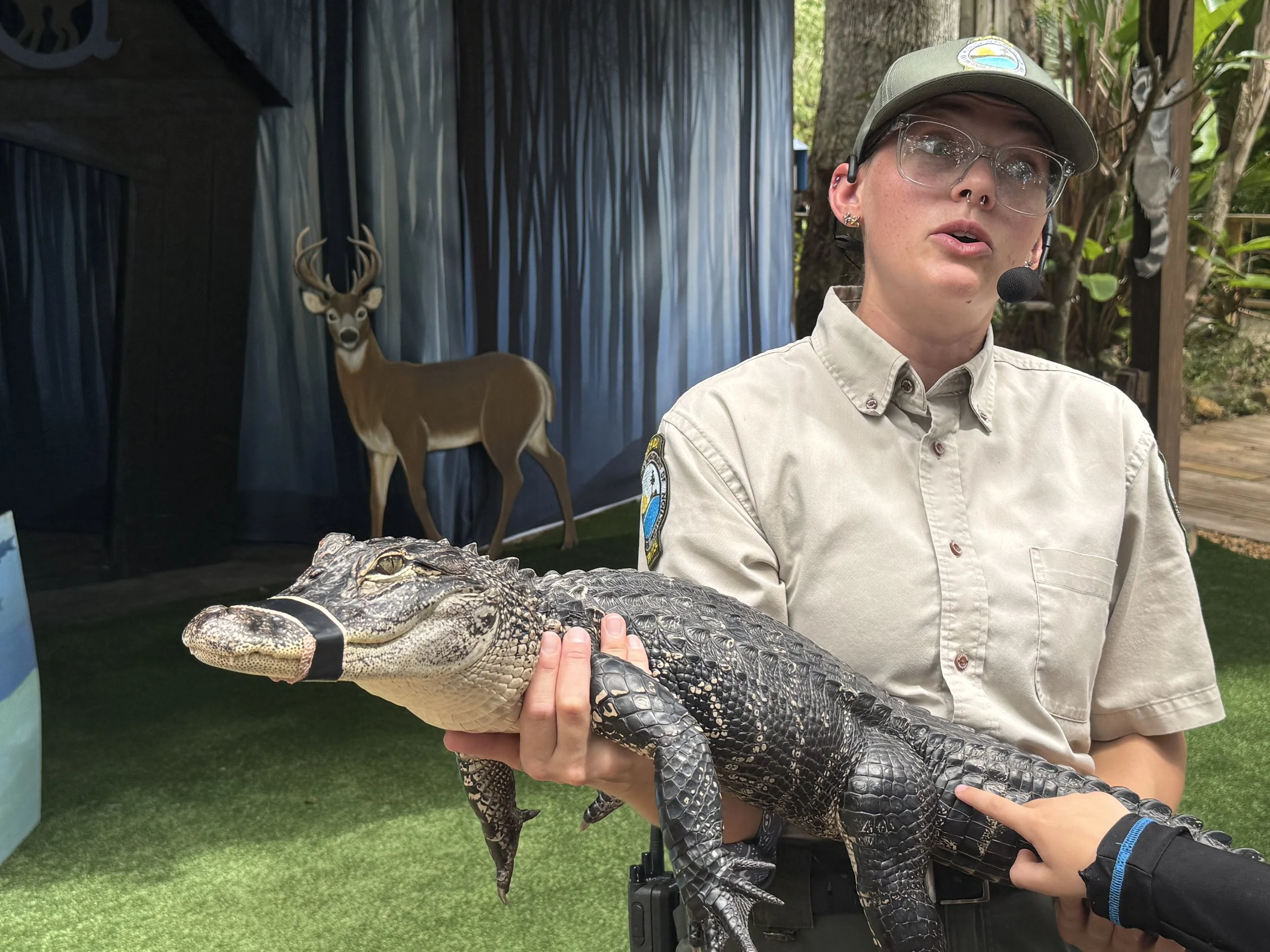
A park ranger’s wildlife show, Weeki Wachee, 2026.
The nature trail, a shrimp basket and a coaster
From the rangers, I took the nature trail. It runs within sight of the river, and it was so quiet that the highway felt very far away.
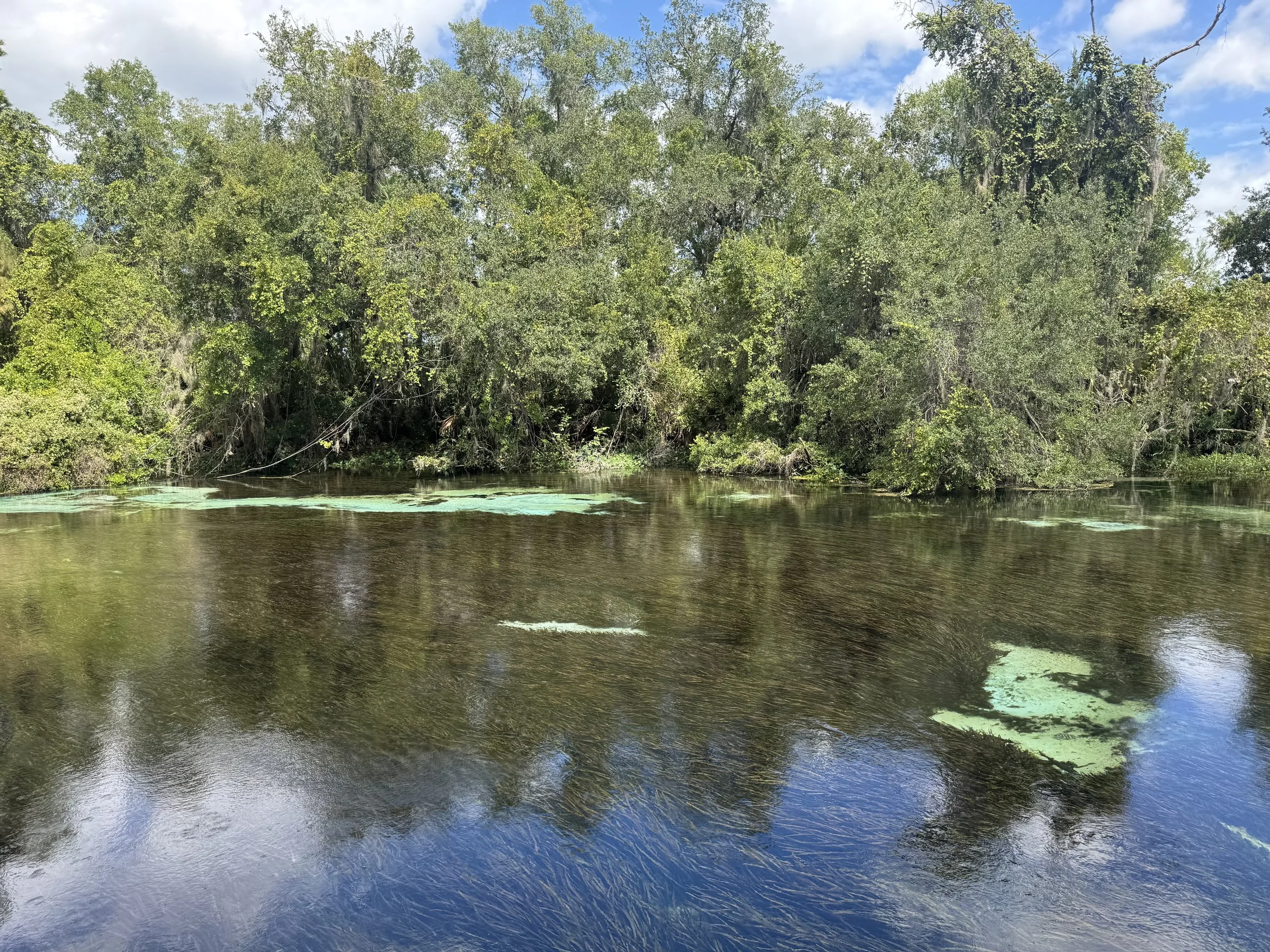
The spring at Weeki Wachee, 2026.
Then I came back for lunch at the restaurant on site. It's typical park food, fried and served with a dipping sauce. Mine was peri peri shrimp, so it had a nice kick.
After lunch I browsed the gift shops and bought a coaster: coral, with the mermaids in white silhouette, drawn in the style of the 1950s and '60s.
Then I walked around to the lagoon, where people swim and play in the sand. It was quiet, because it was late in the season. If you live nearby, the annual pass looks like a wonderful deal. You could come any day you like, and that is what I'd recommend to anyone local.
Three o'clock: when the curtain goes up
At three o'clock, I went into the theater. It's the same room it has been for sixty-some years. It's cool inside, and the wooden benches are hard, but the room wraps around you. Then the curtains go up, and the blue of the water fills the whole space. Because this is a real spring, you can see forever.
The show told us that no one has ever found the bottom, and that is no exaggeration. Cave divers have followed the spring down to 407 feet, which in 2007 made it the deepest underwater cave known in the United States. Its passages keep going, and no one yet knows where all that water comes from.
This year's show tells the history of Weeki Wachee, from the creation of the springs through the founding of the park to where things stand now. Much of it is projected, and then the swimmers arrive and perform. I loved the interviews with former mermaids, who are still a tightly knit group. They reminded me of the women who played in the women's professional baseball leagues.
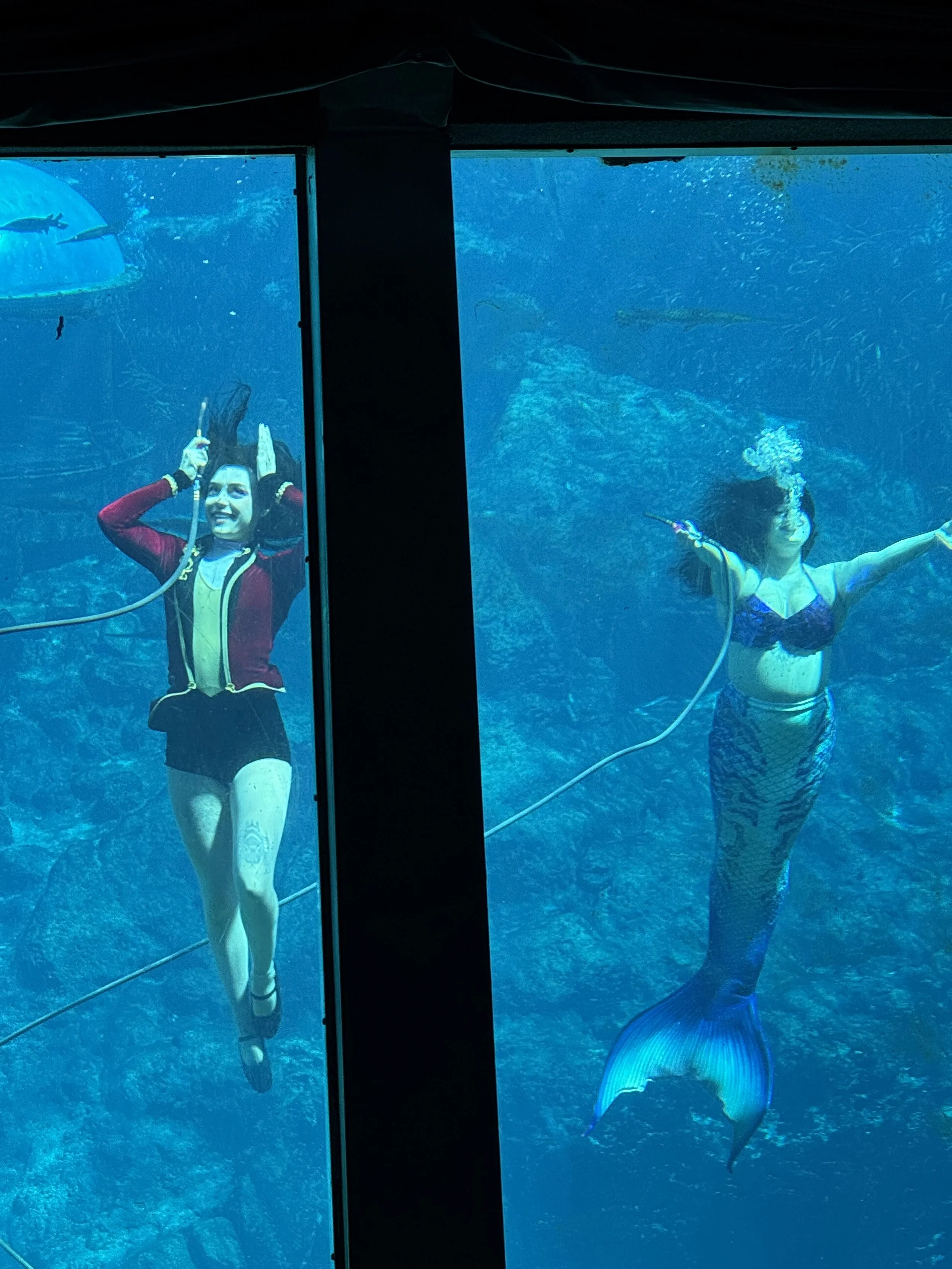
Mermaids in the spring, 2026.
Horse ranches and orange groves
From Weeki Wachee I kept north on U.S. 19. Somewhere near Homosassa it joins U.S. 98, and the country opens up. When you drive the back roads of Florida, you understand how much of the state is still rural and agricultural. I passed horse ranch after horse ranch. The numbers bear that out: in Levy County alone, the most recent Census of Agriculture counted 993 farms covering nearly 200,000 acres, and 4,927 horses and ponies. The county ranks third in Florida for horse sales.
The orange groves are disappearing quickly. In 2002, Florida had 797,303 acres of commercial citrus. This year it has 165,359, a fifth of that, and a drop of 21 percent in just the last year. There are still a couple of groves left on the back roads.
Why I take the long way
Leaving the interstate gives you the local feeling of a place. The interstate has chain restaurants, gas stations and the same few things to do at every exit. The back roads are where the local businesses are, run by people who have real insight into their region. When I stop there, my money goes to a family that has invested in that place, or, in this case, to the state park system. I would much rather support them than another corporate giant.
Who should go
I would send anyone to Weeki Wachee who wants to experience the kitsch and joy of old Florida, and who loves it sincerely, for everything the place represents. I always want to hold on to places like this. To me, it's like a castle or a classical ruin: we need to keep it going so we can go on appreciating the place and the time it represents. If you love finding retro places that have survived against the odds, this one is for you.
From there I kept heading north, much of the way on U.S. 13, all the way home to Betterton.
If you'd like a road trip that takes the long way, with the stops planned and the back roads mapped, let's talk about it. Tell me about the trip you're dreaming of.
Photographs by Joan, except where noted. Historic photographs courtesy of the State Archives of Florida, Florida Memory.
